
Generative AI in Enterprise Decision-Making 2026: A Strategic Guide for Modern Enterprises
Turning Data Into Strategic Business Advantage
Generative AI in enterprise decision-making is transforming how organizations convert massive volumes of data into faster, smarter, and more strategic business decisions.
Today’s enterprises are not limited by data availability, they are limited by their ability to act on it quickly and effectively.
In 2026, Generative AI is shifting enterprise systems from traditional analytics toward real-time decision intelligence, enabling leaders to move from reactive reporting to proactive execution.
Instead of only describing what has already happened, Generative AI enables enterprises to understand:
- What is happening across the business in real time?
- Why specific patterns, trends, or risks are emerging?
- What is likely to happen next based on predictive signals?
- What actions leadership should take to improve outcomes?
This shift is redefining how modern enterprises operate, plan, and compete in increasingly complex markets.
What Is Generative AI in Enterprise Decision-Making?
Generative AI in enterprise decision-making refers to AI systems that analyze structured and unstructured business data and generate actionable outputs such as insights, forecasts, recommendations, and scenario simulations.
It functions as a decision intelligence layer between enterprise data systems and leadership decisions.
Unlike traditional analytics tools, which focus on static reporting, Generative AI continuously interprets data, identifies patterns, and recommends next-best actions in real time.
This enables enterprises to move from retrospective analysis to forward-looking decision intelligence.
Traditional Analytics vs Generative AI
Traditional analytics systems and Generative AI differ significantly in how they support enterprise decision-making.
Traditional Analytics
- Focuses on historical and descriptive reporting
- Requires manual interpretation of dashboards and reports
- Produces static insights that quickly become outdated
- Supports reactive decision-making based on past data
Generative AI
- Generates predictive and forward-looking insights
- Provides automated recommendations for decision-makers
- Simulates multiple business scenarios before execution
- Summarizes large and complex datasets into actionable intelligence
- Supports real-time and continuously evolving decision-making
This evolution enables enterprises to shift from understanding what happened to actively shaping what will happen next.
Why Enterprises Are Adopting Generative AI in 2026
Enterprises are rapidly adopting Generative AI in enterprise decision-making because modern business environments require faster, more accurate, and adaptive decision systems.
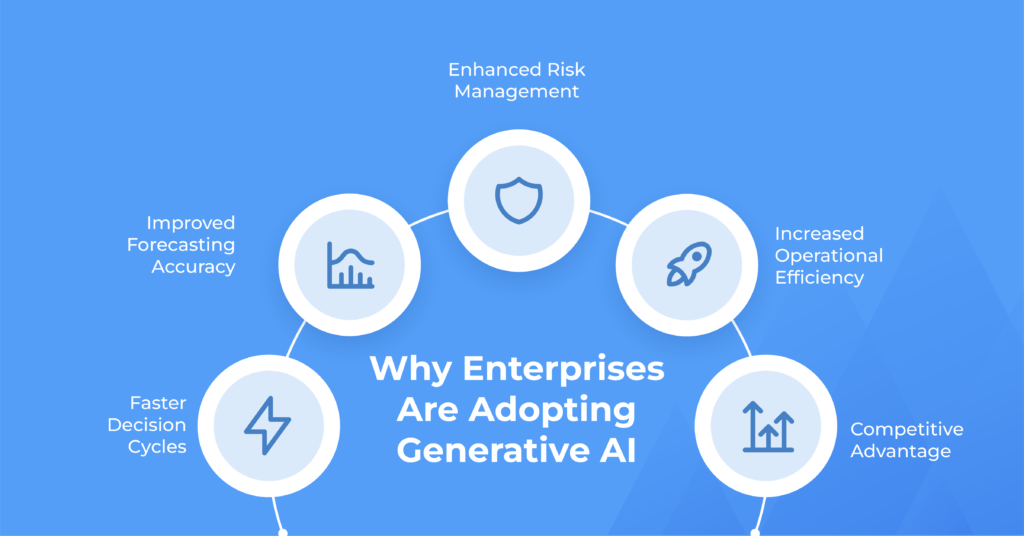
1. Faster Decision Cycles
Generative AI significantly reduces the time required to process, analyze, and interpret enterprise data. This enables leadership teams to move from insight generation to decision execution much faster than traditional systems allow.
2. Improved Forecasting Accuracy
AI models identify complex patterns across large datasets, improving the accuracy of demand forecasting, revenue predictions, and market trend analysis.
3. Enhanced Risk Management
Organizations can detect anomalies, operational risks, and market uncertainties earlier in the decision-making cycle, allowing proactive mitigation strategies.
4. Increased Operational Efficiency
By automating data analysis and insight generation, teams spend less time gathering information and more time focusing on execution and strategic priorities.
5. Competitive Advantage
Organizations leveraging AI-driven insights gain the ability to respond faster to market changes, customer behavior shifts, and emerging opportunities.
How Generative AI Transforms Enterprise Decision-Making
Generative AI in enterprise decision-making delivers measurable impact across core business functions.
Strategic Decision-Making
Generative AI enables leadership teams to evaluate market conditions, identify growth opportunities, and simulate strategic scenarios before making long-term decisions. This reduces uncertainty and improves confidence in strategic planning.
Financial Planning & Analysis
AI enhances financial decision-making by improving revenue forecasting, optimizing budget allocation, identifying cost-saving opportunities, and simulating multiple financial scenarios for better planning accuracy.
Customer Intelligence
Enterprises use Generative AI to analyze customer behavior, predict future needs, and deliver personalized experiences at scale, improving engagement and retention outcomes.
At this stage, many organizations accelerate implementation through enterprise AI platforms such as K2X AI Services, which help convert customer and operational data into structured business intelligence.
Operational Optimization
Generative AI identifies inefficiencies in business processes, improves workflow design, and supports more effective resource allocation across departments.
Supply Chain Intelligence
AI improves demand forecasting, inventory planning, logistics optimization, and risk detection across complex supply chain networks, enabling more resilient operations.
Advanced organizations often extend these capabilities using scalable systems such as SquareX AI Solutions, designed for enterprise-wide AI integration and intelligence deployment.
Enterprise Decision Intelligence Framework
Successful Generative AI adoption requires a structured framework that connects data, intelligence, governance, and execution into a unified system.
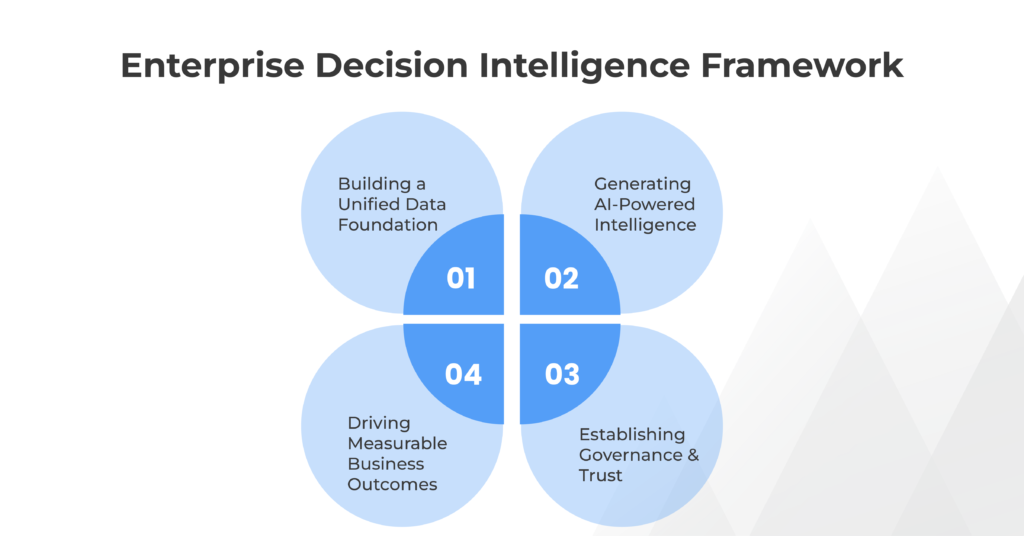
1. Data Foundation
Enterprise decision-making begins with high-quality, unified, and reliable data sourced from multiple systems, departments, and operational workflows.
2. Intelligence Layer
Generative AI processes this data to generate insights, predictions, and actionable recommendations that support business decisions in real time.
3. Governance Layer
Governance ensures that AI-generated outputs remain secure, compliant, transparent, and aligned with enterprise policies and ethical standards.
4. Execution Layer
Insights generated by AI are translated into real-world business actions that improve performance, efficiency, and strategic outcomes.
Key Trends Shaping Enterprise Decision-Making in 2026
While Generative AI delivers significant advantages, enterprises must address several critical challenges during adoption.
Several major trends are accelerating Generative AI in enterprise decision-making:
- Decision Intelligence Platforms combining AI, analytics, and automation
- Industry-Specific AI Models improving sector-level accuracy.
- AI Governance at Scale becoming a compliance requirement.
- Agentic AI Systems enabling semi-autonomous decision workflows.
- Human-AI Collaboration as the standard enterprise model.
Key Challenges in Adopting Generative AI
Data Quality & Consistency
AI performance depends heavily on clean, structured, and reliable data. Poor data quality directly impacts decision accuracy.
Governance & Compliance
Organizations must establish clear frameworks for accountability, transparency, and compliance in AI-driven decision-making processes.
Security & Data Privacy
Enterprise data must be protected across all AI systems to ensure confidentiality and regulatory compliance.
Organizational Change Management
Teams and leadership structures must adapt to AI-supported workflows and new decision-making models.
System Integration
Generative AI solutions must integrate seamlessly with existing enterprise platforms, tools, and workflows.
The Future of Enterprise Decision-Making
Enterprise decision-making is evolving toward systems that are real-time, predictive, and intelligence-driven.
Organizations are increasingly moving toward:
- Real-time business intelligence systems
- Predictive decision-making models
- Autonomous AI-assisted workflows
- Deep human-AI collaboration frameworks
In this new landscape, organizations that successfully integrate Generative AI will gain a significant advantage in speed, accuracy, efficiency, and market responsiveness.
In 2026, competitive advantage is no longer defined by access to data—but by how quickly organizations can turn that data into decisions.
Conclusion
Generative AI is transforming enterprises from traditional data-driven organizations into intelligence-driven systems.
Instead of relying on static reports and delayed insights, businesses can now operate using real-time, AI-generated intelligence that supports faster and more accurate decisions.
The real value of Generative AI is not automation alone, but the acceleration of decision-making at scale.
Organizations that adopt this approach early will be better positioned to innovate, adapt, and lead in the evolving digital economy.
Frequently Asked Questions (FAQs)
What is Generative AI in enterprise decision-making?
It refers to AI systems that generate insights, forecasts, and recommendations to support business decisions in real time.
How does Generative AI improve decision-making?
It improves decision-making by accelerating analysis, enhancing forecasting accuracy, and generating actionable insights.
Which industries benefit most from Generative AI?
Industries such as finance, healthcare, retail, manufacturing, logistics, and technology benefit significantly.
Does Generative AI replace human decision-makers?
No. It enhances human decision-making by providing intelligence, recommendations, and predictive insights.