
Building Agentic Ai Application With A Problem-First Approach
Learn how building agentic AI applications with a problem-first approach can solve real business problems. Explore the methodology, success stories, and best practices for integrating AI into your enterprise.
The field of agentic AI is growing rapidly, with the market projected to expand from $4.3 billion today to over $100 billion by 2034. However, despite the hype surrounding agentic AI, many projects fail to deliver value. The difference between success and failure often lies in the approach taken. A problem-first approach to building agentic AI applications is the key to ensuring these systems create measurable, lasting value.
In this article, we’ll explore why a problem-first approach is critical for developing successful agentic AI systems, how it works, and the tangible value it can bring to your business.
What makes agentic ai different?
Unlike traditional AI systems, which typically respond to specific inputs, agentic AI is designed to take proactive action. Rather than simply answering questions or performing tasks when prompted, an agentic AI system can observe its environment, make decisions based on that observation, and act on those decisions independently.
For example, imagine a virtual assistant that doesn’t just answer “What’s the weather today?” but also notices you have an outdoor meeting scheduled and proactively suggests rescheduling or moving the meeting indoors due to expected rain. This level of autonomy is what sets agentic AI apart from simpler, reactive AI systems.
Agentic AI systems go beyond basic commands—they continuously loop through tasks, adjust strategies based on feedback, and execute complex workflows, all with minimal human intervention.
Building agentic ai applications with a problem first approach
A problem-first approach is about focusing on real-world issues before jumping into solutions. It’s crucial to understand the problem you’re solving and the expected outcomes before selecting tools, models, or frameworks. This approach contrasts with the common “tool-first” mindset, where businesses might choose a technology and then try to fit it to a problem.
Here’s how the problem-first approach works:
1. Define the problem clearly
Start by identifying the core issue. Whether it’s automating a repetitive task in customer service or improving leadership decision-making, having a precise problem statement is essential for success.
2. Align the solution with business goals
Once the problem is defined, the next step is to align the AI solution with measurable business goals. This alignment ensures the AI application directly contributes to solving the problem and driving tangible outcomes.
3. Select the right tools & frameworks
Only after understanding the problem and business objectives do you choose the appropriate tools, models, and frameworks. This avoids the pitfalls of overengineering and ensures that the technology directly supports the defined problem.
Why problem first approach matters
Starting with the problem rather than the technology offers several advantages:
Reduces Complexity: By clearly defining the problem, businesses avoid building overly complex systems that don’t address actual needs.
Improves Reliability: Well-defined boundaries and responsibilities for the AI agents lead to more predictable and reliable outcomes. Without a clear problem, AI systems can make decisions that are misaligned with business goals.
Optimizes Resources: The problem-first approach helps reduce unnecessary resource allocation by focusing only on what’s essential to solve the defined problem. It ensures that the AI solution remains cost-effective and efficient.
How Does Building Agentic AI Applications with a Problem-First Approach Work?
Building agentic AI applications with a problem-first approach involves a structured lifecycle that translates problems into AI system design. Here’s the process:
1. Define the Problem Precisely
Begin by drafting a problem statement that outlines the context, pain points, stakeholders, and constraints. This step is critical in creating a focused solution. For instance, if customer support agents spend 40% of their time on repetitive tasks like summarizing tickets, the problem might be defined as “Automating repetitive support tasks to free up time for more complex issues.”
2. Decide if an Agentic AI System is Needed
Not every problem requires agentic AI. Assess whether the task involves multi-step reasoning, decision-making over time, or the need for tool interaction. If the answer is no, a simpler solution like a rule-based system may suffice.
3. Define Agent Responsibilities
Once it’s determined that agentic AI is the right solution, the next step is to define what the AI agent is responsible for. What decisions can it make autonomously? What actions require human approval? This helps prevent overpowered agents and ensures the system has clear roles.
4. Map the Problem to Workflows
Break down the problem into specific steps and workflows. This includes defining how data will be ingested, processed, and acted upon. It’s essential to ensure that the workflow aligns with both the AI system’s capabilities and the business objectives.
5. Select Models, Tools, and Frameworks
Only after the problem and workflow are defined do you select the appropriate tools and frameworks. This ensures that the chosen technology directly supports the problem, rather than the technology being forced to fit a vague problem.
Where agentic ai delivers real value
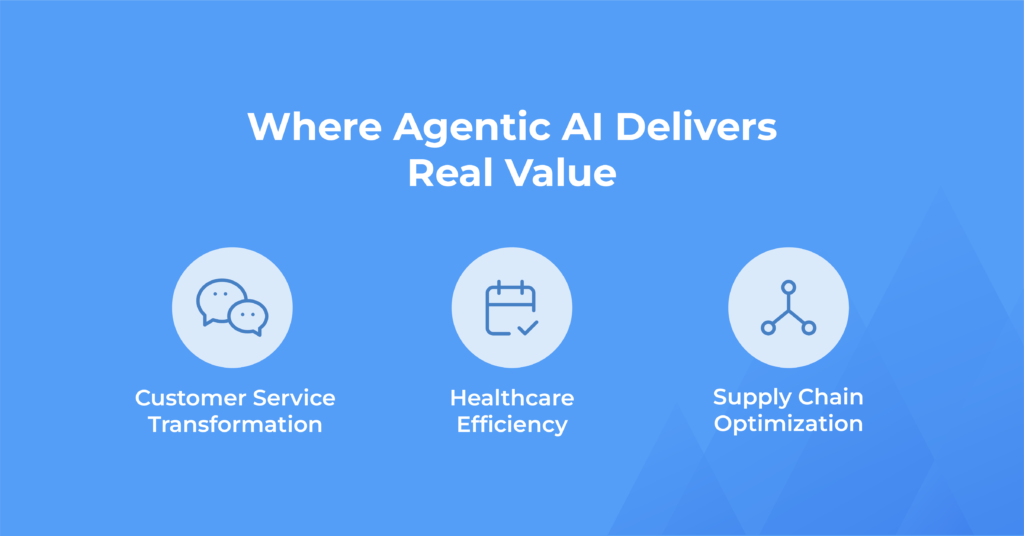
Agentic AI excels when it addresses repetitive, high-volume tasks that require decision-making, real-time analysis, and multi-step workflows. Here are a few examples of how agentic AI has created significant value across industries:
- Customer Service Transformation: Klarna’s AI system handles over 2.3 million conversations per month, reducing the workload of human agents by automating order issues, refunds, returns, and personalized shopping guidance.
- Healthcare Efficiency: Emirates Hospital reduced appointment no-shows by 50%, from 21% to 10%, by implementing an AI system that personalizes reminders, handles rescheduling, and follows up after appointments.
- Supply Chain Optimization: DHL’s autonomous routing agents optimize delivery routes based on real-time conditions, improving on-time deliveries by 30% and saving 20% on fuel costs.
These are just a few examples of how agentic AI, when designed with a problem-first approach, can provide measurable improvements.
Why most fail
Despite the significant potential of agentic AI, many projects fail due to a few common mistakes:
- Vague Problem Definitions: Without a clear problem statement, it’s difficult to measure success. AI systems that aren’t aligned with a concrete goal are doomed to fail.
- Overengineering: Adding unnecessary complexity can hinder adoption. Focused, simple solutions are often more effective than trying to create an all-encompassing AI system.
- Lack of Evaluation and Feedback: Continuous monitoring and feedback loops are essential to ensure that the AI system is improving and evolving to meet business goals.
From gold rush to gold standard
While the AI industry has seen a gold rush mentality, where businesses rush to adopt AI without a clear strategy, the shift is happening. The organizations that succeed will be the ones that focus on solving specific business problems with clear, measurable outcomes. They will define success in numbers, using AI not as a buzzword, but as a practical tool to improve efficiency, reduce costs, and create value.
FAQs
What is the problem-first approach in agentic AI?
A problem-first approach involves clearly defining the problem and success criteria before choosing any AI tools or frameworks. This ensures the solution is directly aligned with real business needs and provides measurable outcomes.
How do you know if a problem requires agentic AI?
If the task involves multi-step reasoning, decision-making, or tool interaction over time, agentic AI may be justified. Simpler tasks can be handled by rules-based systems or automation.
Why is the problem-first approach so important for AI projects?
This approach ensures that AI systems solve real, measurable business problems. It reduces unnecessary complexity, improves system reliability, and optimizes resource use, making AI solutions more cost-effective.
What are the risks of not using a problem-first approach?
Skipping the problem-first approach often leads to overcomplicated systems, vague goals, and poor alignment with business objectives. Without clear problem definitions, it’s difficult to measure success and deliver meaningful value.
Design and Build Impactful Agentic AI Systems to Solve Business Problems
At K2X Tech, we specialize in designing and building agentic AI systems tailored to your business needs. Whether you want to automate customer service, optimize leadership development, or improve operational workflows, our problem-first approach ensures that every AI solution we build directly addresses your business goals.
Contact us today to explore how we can help you integrate agentic AI applications that deliver tangible results. Let’s work together to create AI systems that not only meet your objectives but also transform your business operations.